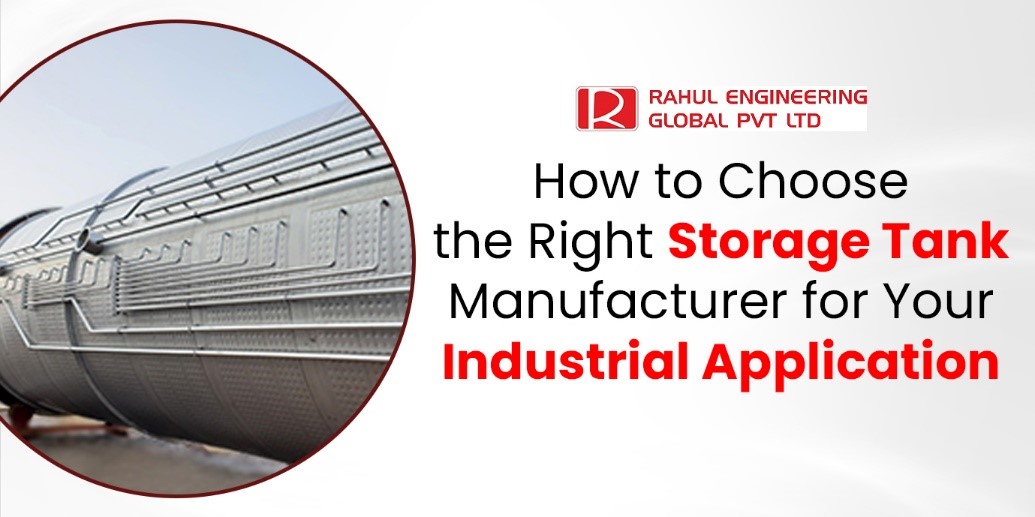
How to Choose the Right Storage Tank Manufacturer for Your Industrial Application
Choosing the right storage tank manufacturer is an important decision for industries that handle water, chemicals, oils, solvents, raw materials, and other process fluids. A storage tank is not simply a container; its material, design, capacity, fabrication quality, and operating conditions can directly affect plant safety, efficiency, and maintenance requirements.
With different tank designs and fabrication materials available, companies should evaluate a manufacturer's technical capabilities before placing an order.
What Is an Industrial Storage Tank?
An industrial storage tank is designed to safely store liquids, chemicals, process materials, or other substances for a specific period. Depending on the application, tanks can be manufactured in different shapes, capacities, materials, and configurations.
Common options include:
Vertical storage tanks
Horizontal storage tanks
MS storage tanks
SS storage tanks
Chemical storage tanks
Process storage tanks
Custom-fabricated storage tanks
The appropriate tank depends on factors such as the stored material, operating temperature, pressure, capacity, installation area, and industry requirements.
How to Select the Right Storage Tank Manufacturer?
1. Check Manufacturing and Fabrication Experience
Experience in industrial fabrication is an important factor when selecting a manufacturer. A capable manufacturer should understand material selection, fabrication methods, welding requirements, dimensional accuracy, surface treatment, and inspection procedures.
For customized projects, technical experience becomes even more important because the tank may need to be designed according to specific process conditions.
2. Consider the Tank Material
The material used for manufacturing the tank should be compatible with the stored substance and operating environment.
Common materials include:
Mild Steel (MS):
Suitable for many general industrial storage applications where corrosion resistance requirements are moderate.
Stainless Steel (SS):
Often selected for applications requiring better corrosion resistance, hygiene, or compatibility with specific chemicals and process materials.
The manufacturer should be able to recommend an appropriate material based on the application rather than using the same material for every tank.
3. Select the Correct Tank Capacity and Configuration
Storage capacity should be determined according to production requirements, available space, material volume, and process requirements.
Depending on the application, a tank may be designed as a vertical or horizontal vessel. The manufacturer should consider factors such as:
Required storage capacity
Available installation space
Tank dimensions
Accessibility
Inlet and outlet locations
Drain arrangements
Support structure
Transportation and installation requirements
4. Look for Custom Design Capability
Many industrial applications cannot be addressed with an off-the-shelf tank.
A custom storage tank manufacturer can develop tanks according to project-specific requirements such as capacity, dimensions, nozzle orientation, material, internal components, supports, and installation conditions.
This is particularly useful for chemical processing, manufacturing, pharmaceutical, food processing, and other specialized industries.
5. Ask About Quality Control and Inspection
Storage tanks used in industrial environments should undergo appropriate quality checks during fabrication.
Depending on the project, inspection may include:
Dimensional inspection
Welding inspection
Visual inspection
Leak testing
Surface inspection
Material verification
Final inspection
The exact inspection requirements should be established according to the tank design, application, and applicable project standards.
Storage Tanks for Different Industries
Industrial storage tanks are used across a wide range of sectors.
Chemical Industry: Chemical plants may require tanks designed for storing corrosive or reactive materials. Material compatibility and appropriate fabrication practices are particularly important in these applications.
Pharmaceutical Industry: Pharmaceutical applications may require stainless steel tanks with suitable surface finishes and hygienic design considerations.
Food and Beverage Industry: Storage tanks used in food processing generally require materials and designs appropriate for hygienic processing and cleaning requirements.
Water and Process Industries: Storage tanks can be used for raw water, treated water, process fluids, and other industrial liquids.
Manufacturing Industry: Manufacturing plants may use storage tanks for oils, chemicals, process fluids, raw materials, and other production requirements.
Why Choosing the Right Manufacturer Matters
A storage tank manufacturer is responsible for more than fabrication. The manufacturer should understand the complete requirement, from initial design and material selection to fabrication, inspection, finishing, and delivery.
Working with an experienced manufacturer can help ensure that the tank is designed according to the intended application and site requirements.
Before finalizing a supplier, businesses should evaluate:
Manufacturing capabilities
Engineering and design support
Material options
Fabrication facilities
Quality control process
Customization capabilities
Previous industrial experience
Inspection and testing procedures
Installation or site support, where required
FAQ: Frequently Asked Questions
Stainless steel tanks are ideal due to hygiene and corrosion resistance.
FRP tanks are widely used because of their chemical resistance.
Regular inspection and cleaning should be done every 3–6 months.
Depending on material, tanks can last 10–30 years or more.